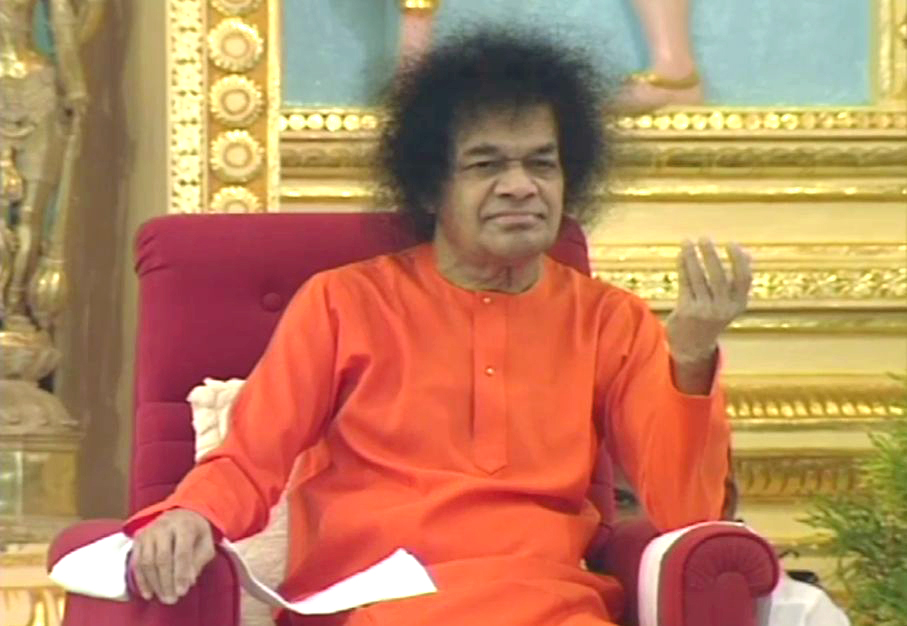
“Makara Sankranthi marks the movement of the Sun from the southern horizon to the northern horizon. This northward movement of the Sun has immense spiritual significance. The north is symbolised by Himaachala. Hima means snow. It is pure, untainted and soothingly cool. All these endow it with the quality of Prashanthi (perfect peace). Achala means that which is steady and unshakeable. Himaachala does not refer to the physical Himalayan mountains. It represents that which is cool, peaceful and steady. From this day the Sun is said to move towards such a state. The Sun symbolises the vision of man. The northward movement of the Sun is a call to human beings to turn their vision towards that which is cool, peaceful and unchanging, i.e. towards the divinity within.
– Divine Discourse: 14 January, 1994
The astronomical Uttarayana comes to you whether you strive for it or not; it is part of the law of nature. But for the real Uttarayana, you must make efforts, tremendous efforts. Know that there are only two entities: the substance and the shadow, (or, rather, only One and its appearance, produced by ignorance), the atma and the anatma, the seer and the seen, the rope and the snake. When this knowledge becomes part of the mental make-up, it liberates you from delusion, and you see Kailas (Siva’s mountain abode) at the end of the northward journey. Like Kailas, that stage is all light, all white. The path is straight and hard but the goal is glorious; it is nothing less than Illumination. It is when people forget this goal that the Avatar comes to save them.
Sathya Sai Speaks, Vol. 2 Ch. 29, January 14, 1962
Years come and go, so also pleasure and pain. Nothing confers permanent bliss except the experience of the Atma (Self). Man cannot attain peace and happiness from his actions unless he has sacred feelings within. Many people expect the New Year to confer happiness and prosperity on them. But in fact, New Year only confers on you the results of your past actions. In order to atone for your past sins, you have to cultivate sacred qualities and involve yourself in sacred activities more and more in the New Year. In fact, Bliss is within you, it originates from your sacred feelings. So, you have to manifest bliss from within – it cannot be bestowed on you by others. None can take away the bliss from you and you cannot obtain it from outside.
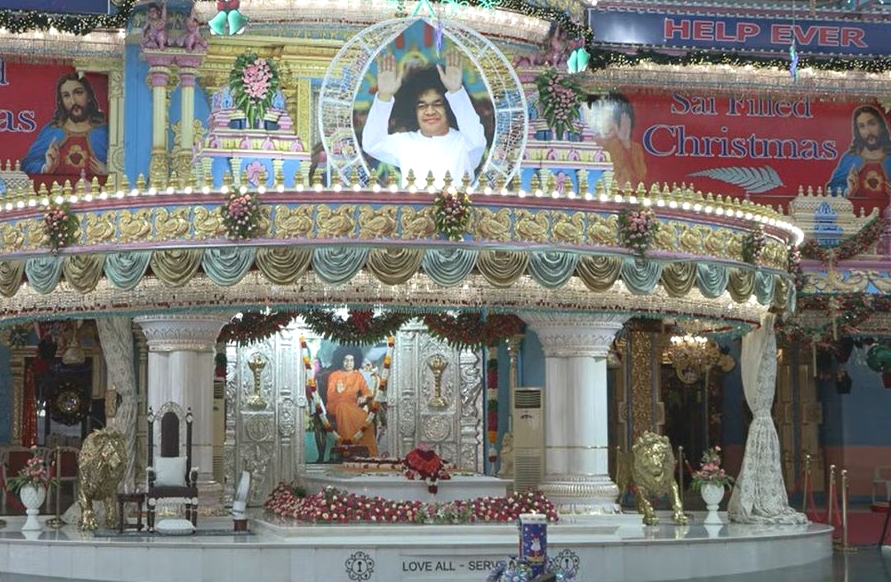
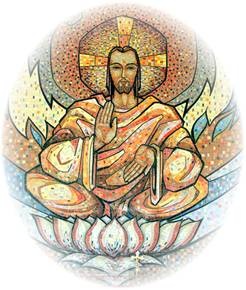
There was a huge halo of splendour illuminating the sky over the village when Christ was born. This meant that He, who was to overcome the darkness of evil and ignorance had taken birth, that He will spread the Light of Love in the heart of man and councils of humanity.
Appearances of splendour, and other signs to herald the era that has dawned are natural when incarnations happen on earth. Jesus was to shatter the darkness that had enveloped the world and the aura of light was a sign that announced the event.
The Masters arrive in answer to man’s prayer.
“Thamaso maa jyothir gamaya” (Lead us from darkness unto Light!)
Make your hearts pure, your activities holy, and your feelings beneficial to all.
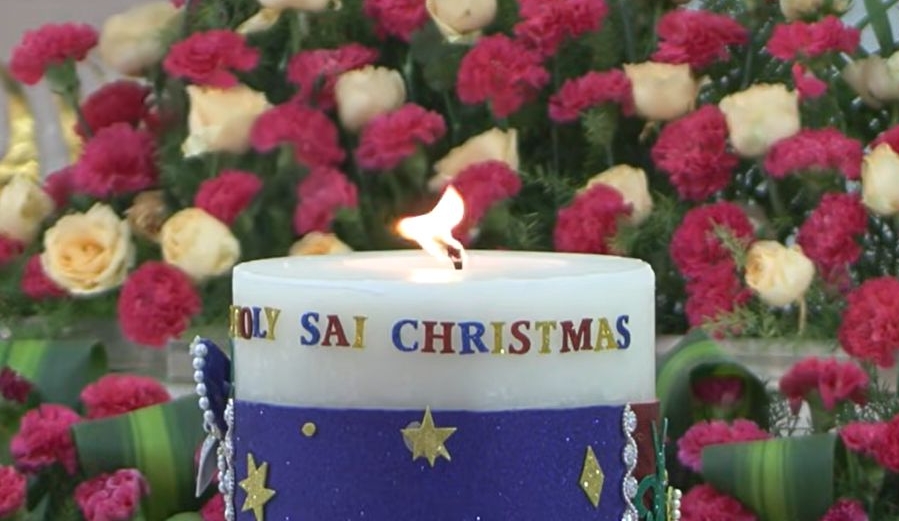
That is the best way of celebrating the Birth of Christ. – Sathya Sai Baba
It was to teach mankind the greatness of divine love that Jesus came. He resolved on three tasks: one, to be filled with Divine love and to share it with others – this was the main purpose of his life; two, he should not succumb to praise or censure in carrying out his mission; three, to inspire in others the conviction that the Divinity within is omnipresent. Jesus considered spreading the gospel of love as his foremost task. He encountered many ordeals in carrying out his mission, but he regarded them all as challenges to be overcome. He was determined to treat pleasure and pain, and sickness and failure with equanimity. He could not bear to see anyone suffer. Every human being is potentially a messenger of God. Humanness demands that everyone should manifest the Divinity within him. Everyone should be a real messenger of God and strive to promote peace and security in the world. There is no other path to be followed.
God’s message is sacred and totally free from self-interest.
– Divine Discourse, Dec 25, 1995
It is therefore appropriate that the Birthday of Jesus, who felt the need to save mankind and who
strove to achieve it, is celebrated; but, the celebration must take the form of adherence to the
teachings, loyalty to the principles, practicing the disciplines and experiencing the Awareness of
There is one point that I cannot but bring to your special notice today. At the moment when Jesus was merging in the Supreme Principle of Divinity, He communicated some news to his followers, which has been interpreted in a variety of ways by commentators and those who relish the piling of writings on writings and meanings upon meanings, until it all swells up into a huge mess. The statement itself has been manipulated and tangled into a conundrum.
The statement of Christ is simple:
“He who sent me among you will come again!” and he pointed to a Lamb.
The Lamb is merely a symbol, a sign. It stands for the Voice—Ba-Ba; the announcement was the Advent of Baba. “His Name will be Truth,” Christ declared.
Sathya means Truth.
“He will wear a robe of red, a bloodred robe.”
(Here Baba pointed to the robe He was wearing!).
“He will be short, with a crown (of hair). The Lamb is the sign and symbol of Love.”
Christ did not declare that he will come again. He said, “He who made me will come again.”
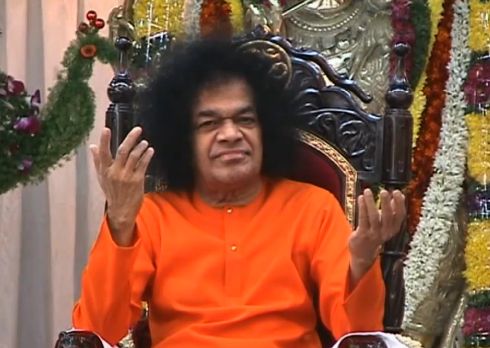
That Ba-ba is this Baba and Sai, the short, curly-hair-crowned red-robed Baba, is come.
He is not only in this Form, but, he is in every one of you, as the dweller in the Heart.
He is there, short, with a robe of the colour of the blood that fills it”
The great axioms of Bhaaratheeya culture found in the Vedas—Ishwarassarvabhuuthaanaam, Isaavaa-yamidham sarvam, Vasudhevassarvamidham–
“God is the inner Motivator of all beings. All this is enveloped in God, All this is Vaasudheva, the Divine”— are to be in every one.
This is the inner mystery of Incarnation, God incarnating in all! All are One; The One is All.
There is only one God; He is Omnipresent. There is only one religion, the Religion of Love;
there is only one caste, the Caste of Humanity; there is only one language, the Language of the Heart.”
The yearning for bliss is the best proof of our holy nature. Man is bliss; He seeks bliss; Bliss is blessedness for him. Since God is bliss, happiness is union with God. Nothing else can award that joy; This joy is unaffected, by whatever happens or does not happen. The heart of Jesus was pure and calm; Therefore, it is honoured as sacred. We must make our hearts sacred, So that either we merge in Jesus or Jesus merges in us. When we merge, it is called Bhakti. To have Jesus awakened in us is called the path of Jnana. Jesus was a Messenger of God; But you should note this also – All of you are messengers of God. Jesus was not the only son of God; You are all His children. Jesus and his Father are one. You and God are also one and you can be aware of it. Christmas Discourse, Prasanthi Nilayam, Sathya Sai Speaks Vol. 15, 25/12/1982
“The Avatar comes to reveal man to himself, to restore to him his birthright of inner Bliss. He does not found a new creed, to breed a new faction, to instill a new God. If such happens, it is the consequence of the evil in man. The Avatar comes as Man in order to demonstrate that Man is Divine, in order to be within reach of Man. The human mind cannot grasp the Absolute, Attributeless Principle; it is Abstract and beyond the ready of Speech, Mind and Intellect. Fire is inherent in the matchstick but it is only when it is struck as flame that we can benefit from it. The Formless has to manifest as Form; the Formless has to appear with Form. Then only can man listen, learn, understand, follow and be saved, through the Bliss of that experience. He lights the flame of Realization in each; and the age-old ignorance is destroyed in an instant.”
– Sathya Sai Baba (Baba the Breath of Sai p.305)
“In this human form of Sai every Divine Entity, every Divine Principle, that is to say all Names and Forms ascribed by man to God, are manifest.”
– Sathya Sai Baba (The Embodiment of Love p.103)
“I have come to repair the ancient highway to God…
Avatars do not succeed or fail; what they will must occur; what they plan must take place… I have come to inscribe a golden chapter in the history of humanity, wherein falsehood will fail, truth will triumph, and virtue will reign. Character will confer power then, not knowledge, or inventive skill, or wealth. Wisdom will be enthroned in the councils of nations.” – Sathya Sai Baba (The Embodiment of Love p.174)
“My Birthday is the Date when Divinity Blossoms in your Heart”
– Sathya Sai Baba
It is a matter of great bliss to be loved by many. To win over the hearts of so many is a sign of Divinity. I love everyone and all love Me. Do not hurt anyone by your harsh words and enter into any evil paths. Recognise the truth that God pervades everything from microcosm to macrocosm. With Shraddha and Vishwasa (sincerity of purpose and faith) and self-confidence, you can achieve anything in the world. Love God from the depths of your heart. Follow Swami’s commands and you will attain everything and be victorious in all your endeavours!
“With holy thoughts in you on this auspicious day, you must go out into the world and spread your sacred feelings among others. Don’t confine your feelings to yourselves or retain them only during your stay here. Spread them wherever you go”.
– Divine Discourse: 23 November 1997
“Today, thousands of people have gathered here. What has brought them together here? Love is the main cause. Without love, but few of you would have come from such distant places. How does this love express itself? It is a process of give and take. You have to receive God’s love, and you have to offer your love to Him. But, both are one and the same love. God’s love is reflected in you. That is the meaning of the declaration in the Bhagawad Geetha: “A spark of Mine is present in every being.”
O, Son of Eswaramba! O, resplendent majestic One! Dawn is breaking in the East. The daily tasks of divinity which you have undertaken, have to be accomplished therefore, Awake! O, Lord Sathya Sai!
For the protection of the virtuous, for the destruction of evil-doers and for establishing righteousness on a firm footing, I incarnate from age to age. Whenever disharmony (asanthi) overwhelms the world, the Lord will incarnate in human form to establish the modes of earning peace (prasanthi) and to reeducate the human community in the paths of peace. At the present time, strife and discord have robbed peace and unity from the family, the school, the society, the religions, the cities, and the state.
Wherever women are honored there is prosperity and happiness. Women should never be slighted or treated with disrespect. A home in which the housewife sheds tears will be bereft of all prosperity. This is the ancient conception of the role of women in the home”.
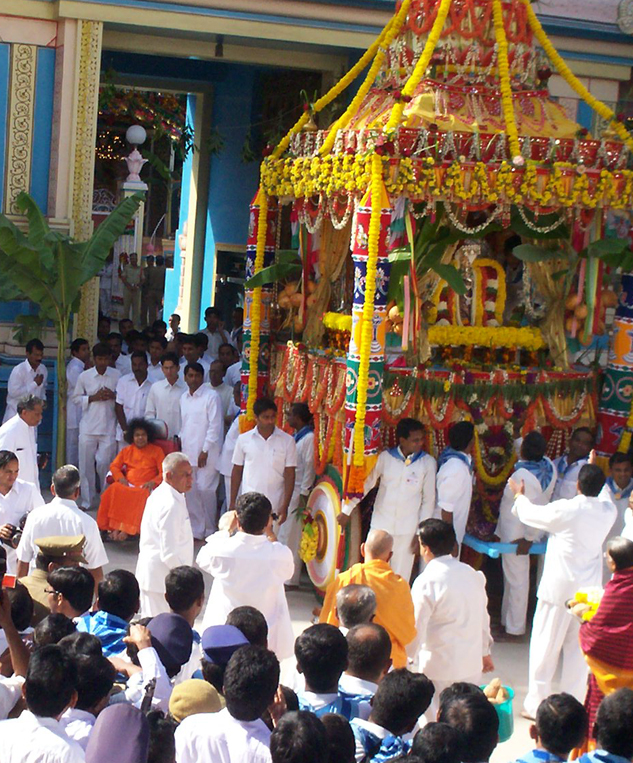
The Rathotsavam (Chariot Festival) at Prasanthi Nilayam is a tradition that goes back to the early 1950’s. This festival marks the beginning of the Birthday Celebrations of Bhagawan Sri Sathya Sai Baba. On this day, the students of Bhagawan, chanting Vedic hymns and singing Bhajans, lead a procession with the idol of Lord Krishna on a rath (chariot) and the idols of Lord Rama, Lakshmana and Mother Sita on a palanquin from Sai Kulwant Hall to the Old Mandir, or what is now the Kalyana Mantapam, in the village of Puttaparthi. After worship is offered to the deities, the idols of Rama, Lakshmana and Sita return to the Mandir. Later, in the evening, the idols are taken out in a procession in the village of Puttaparthi, amidst joyous celebration by the villagers.
Subsequent to the Divine Marriage, ‘The Divine Couple’ along with Lord Venugopala Swami were escorted out in a royal procession as part of the annual Rathotsavam. ‘The Gods’ mounted on a chariot were taken out along the road in royal procession.
Global Akhanda Bhajan, the timeless intonation promoting Universal Peace and Harmony is one of the most significant and far-reaching annual spiritual exercise initiated by Bhagawan way back in the mid forties.
Ever since, every second week-end of the month of November has been a fixed schedule for this 24 hour marathon non-stop bhajan saga.
The Akhanda Bhajan had its origin way back in 1945, started in Bangalore by a group of eight families. Upon the culmination of the year-long Thursday bhajans, they had been conducting quite regularly from 1944, during the World War II time, the group of eight families showed up to Bhagawan in Puttaparthi seeking blessings for conducting bhajans. The Divine Visionary that He is, Bhagawan blessed the group, praising the idea of bhajan singing and named it Akhanda Bhajan. Bhagawan even promised the group that He would bless the same with His physical presence. This grand Spiritual exercise has been going on uninterrupted ever since and the years that passed had been fortunate to have the spirited physical presence of Bhagawan during the occasion.
“Today we are having the Akhanda Bhajan. This is being done not for the sake of one individual, one nation or one community. It is for the welfare of humanity as a whole.
The bhajans that are sung permeate the ether in the form of sound waves and fill the entire atmosphere. Thereby, the whole environment is purified. Breathing in this purified atmosphere, our hearts get purified. Reciting the Lord’s name is a process of give and take. Singing the Lord’s name should become an exercise in mutual sharing of joy and holiness. It should be remembered that the sounds we produce reverberate in the atmosphere. They remain permanently in the ether as waves and outlast the individual uttering the sounds.
– Divine Discourse on Akhanda Bhajan day on November 8, 1986